About the Journal
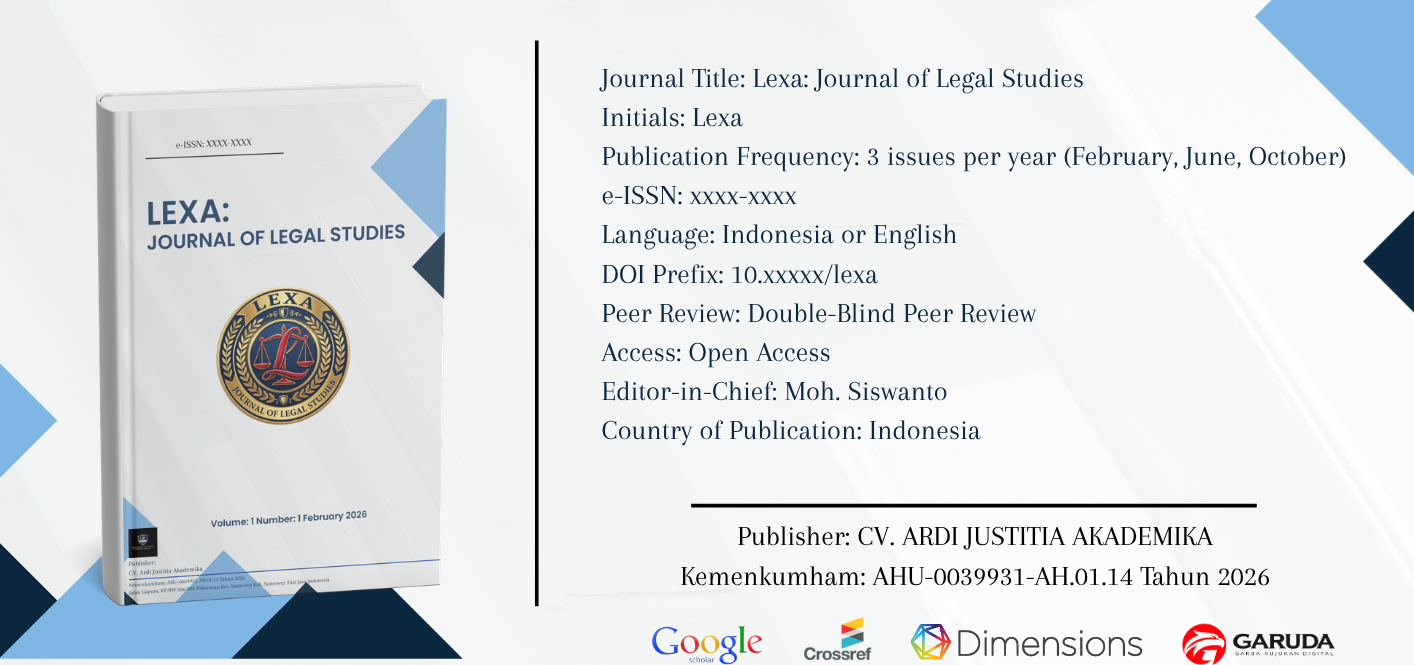
Lexa: Journal of Legal Studies is a peer-reviewed, open-access journal dedicated to the publication of high-quality, original scholarly articles in the field of law. Published periodically three times a year in February, June, and October, the journal serves as a professional forum for lecturers, researchers, legal practitioners, and students to contribute to the advancement of legal science.
Lexa: Journal of Legal Studies is highly committed to becoming a credible, innovative, and influential venue for legal scholarship at both national (Indonesia) and international levels. The journal welcomes manuscripts across a broad spectrum of legal research methodologies, including empirical studies, normative legal research, and critical conceptual analyses relevant to contemporary legal developments.
Peer Review Process
Every submitted manuscript undergoes a rigorous evaluation process. Initial screening is conducted by the Editorial Board to assess compliance with the journal’s focus, scope, and formatting guidelines. Manuscripts that pass the initial screening are subsequently assigned to independent international and national reviewers for a double-blind peer review. This ensures academic integrity, objectivity, and high-quality standards for all published material.
and critical conceptual analyses relevant to contemporary legal developments.
Open Access Policy
This journal provides immediate open access to its content on the principle that making research freely available to the public supports a greater global exchange of knowledge. Users are allowed to read, download, copy, distribute, print, search, or link to the full texts of the articles in this journal without asking prior permission from the publisher or the author. The articles under a Creative Commons Attribution-ShareAlike 4.0 International License (CC BY-SA 4.0).
Current Issue
Vol. 1 No. 2 (2026): Journal of Legal Studies
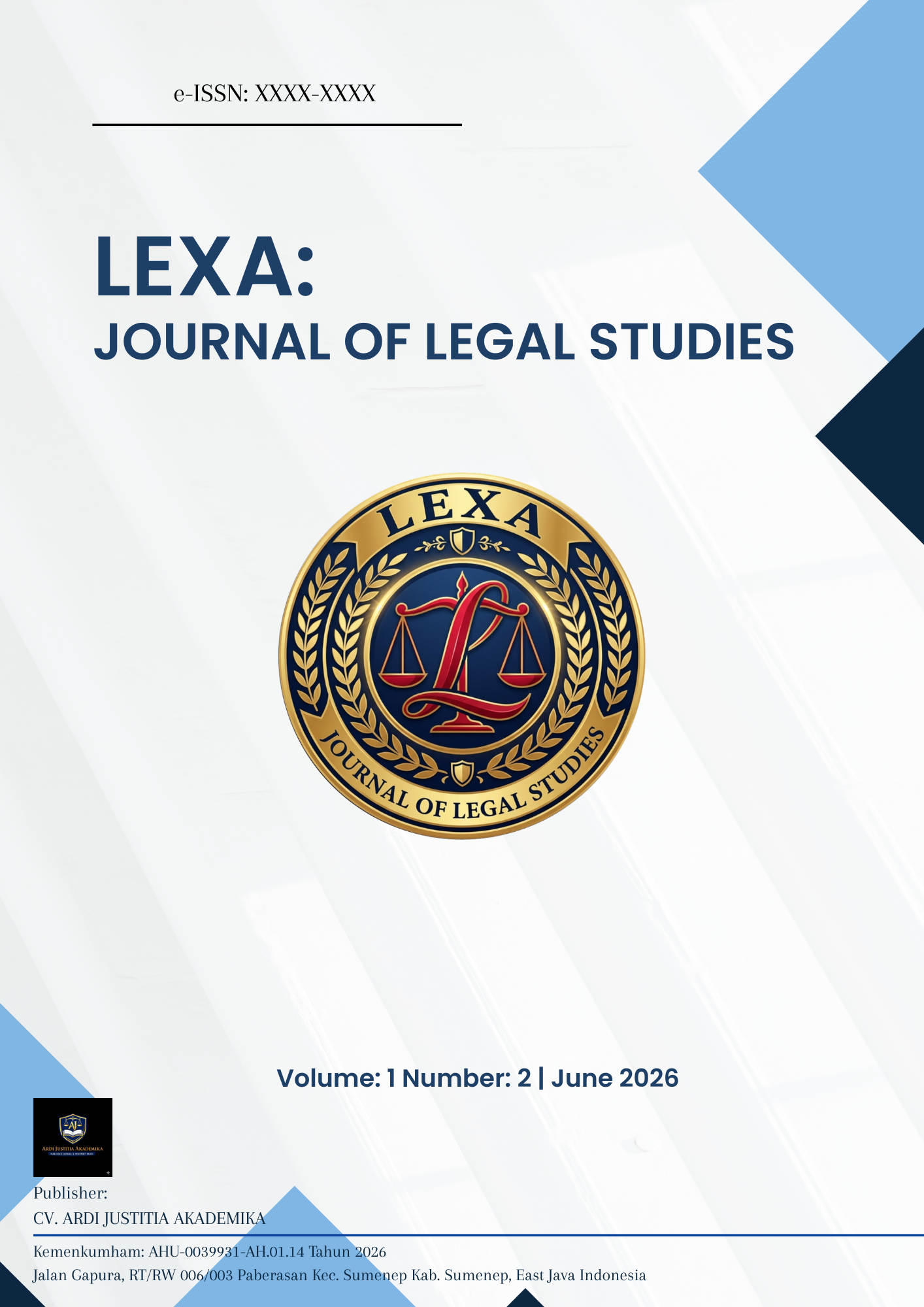
The research articles in this period's issue of the law journal (7 research articles) examine three main pillars: (1) Constitutional Dynamics and Judicial Institutional Reform, which highlights the constitutional normative vacuum in regional head replacements, the determination of a constitutional ceiling for parliamentary thresholds, and the reformulation of selection mechanisms for Constitutional Court justices to ensure judicial independence; (2) Disruption and Reconstruction of State Administrative Law, which analyzes the post-reform abolition of administrative court authority over positive fictitious decisions and the conceptual ambiguity surrounding concrete acts versus factual actions in state administrative disputes; and (3) Business Regulation, Normative Conflicts, and Legal Liability, which focuses on the commercial complexities of lex specialis conflicts within the financial technology services industry and the criminalization of non-performing bank loans from a director's perspective.
The scholarly work in this period is an academic collaboration involving 14 authors from 14 higher education institutions across 8 provinces in Indonesia. This cross-institutional synergy reflects a strategic role in adaptively and equitably responding to contemporary dynamics in constitutional frameworks, public administration reforms, and complex corporate legal responsibilities. This volume is expected to provide a meaningful academic contribution to the advancement of contemporary legal reform in the global era.
Published:
2026-06-30